
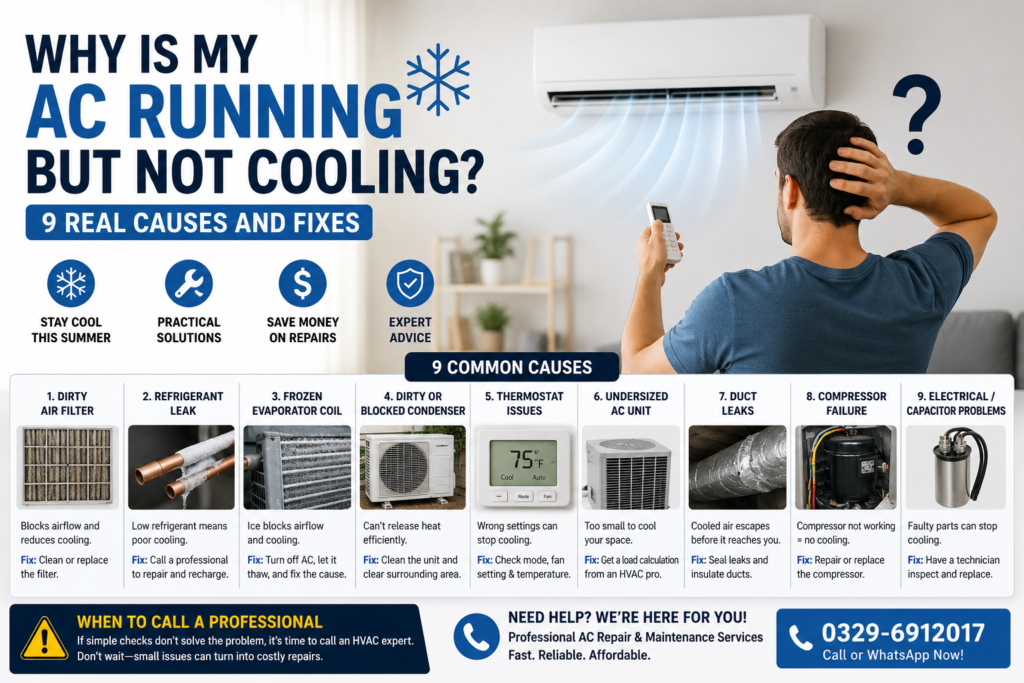
Why Is My AC Running But Not Cooling? 9 Real Causes and Fixes
It’s the middle of summer. Your air conditioner sounds like it’s working fine — the fan is spinning, the unit is humming — but the air coming out of your vents is barely cool. That’s one of the most frustrating situations a homeowner can face.
The good news? Most of the time, there’s a fixable reason behind it. And a few of those fixes you can do yourself without calling a technician.
I’ve been in HVAC for over 15 years, and this is one of the top calls we get every summer. Let’s walk through the most common causes, what they look like, and what you can do about them.
1. Dirty Air Filter
This is the number one culprit we find on service calls. A clogged air filter blocks airflow through your system. When air can’t flow properly, your AC can’t do its job — it runs constantly but never actually cools the house down.
Check your filter. If it’s gray, dusty, or you can’t see light through it, replace it. Most filters should be changed every 1–3 months, depending on how much you use your system and whether you have pets.
A fresh filter is free compared to a repair bill. Always start here.
2. Refrigerant Leak
Refrigerant is the fluid that absorbs heat from the air inside your home and carries it outside. If your system has a leak, there’s not enough refrigerant to transfer heat effectively — so the air stays warm.
Signs of low refrigerant include ice forming on the copper lines near the unit, a hissing or bubbling noise, or warm air blowing from the vents even after hours of running.
This is NOT a DIY fix. Refrigerant is a regulated substance and requires a licensed technician to handle and recharge. If you suspect a leak, call a pro.
3. Frozen Evaporator Coil
If your evaporator coil (the indoor component) freezes up, airflow is completely blocked. Ice on the coil acts like a wall — air can’t pass over it, so nothing gets cooled.
This usually happens because of a dirty filter, low refrigerant, or blocked vents. You might see ice on the copper refrigerant line coming from your indoor unit, or notice your AC blowing warm air after running for a while.
Turn the system off and let it thaw for a few hours. Then fix the root cause before turning it back on.
4. Condenser Unit is Dirty or Blocked
The outdoor unit (condenser) releases heat outside. If it’s clogged with dirt, leaves, or grass clippings — or if shrubs are growing too close — it can’t release heat efficiently.
Walk outside and look at your condenser. The fins on the sides should look like a clean grid. If they’re packed with debris, the unit is working against itself. You can gently clean the fins with a garden hose (spray from inside out) and trim any vegetation within 2 feet of the unit.
5. Thermostat Issues
Sometimes the problem isn’t the AC at all — it’s the thermostat. If it’s set to “fan on” instead of “auto,” the fan runs constantly but the compressor might not be cooling.
Check that your thermostat is set to “cool” mode and “auto” fan setting. Also check that the temperature is set below the current room temperature. It sounds obvious, but we’ve been on service calls where this was all it took.
If your thermostat is old or uses batteries, try replacing the batteries too.
6. Undersized AC Unit
If your system is too small for your home, it will run all day and still never reach your set temperature. This is common in homes where someone added a room addition or enclosed a porch without upgrading the HVAC system.
A properly sized AC unit should cycle on and off throughout the day. If yours runs nonstop and still can’t cool the house, have an HVAC tech do a load calculation to see if your unit is the right size.
7. Duct Leaks
Leaky air ducts can send 20–30% of cooled air into your attic, walls, or crawlspace instead of into your living areas. The system is cooling — just not your house.
Look for visible gaps or disconnected sections in accessible ductwork. You might also notice some rooms are much warmer than others. A professional duct test can identify leaks, and sealing them can make a huge difference in comfort and efficiency.
8. Compressor Failure
The compressor is the heart of your cooling system. If it fails, the fan might still run, but no actual cooling happens. You may hear the unit hum without the compressor engaging, or the circuit breaker for the AC may keep tripping.
Compressor repair or replacement is a major job. Depending on the age of your unit, it may make more financial sense to replace the whole system.
9. Electrical or Capacitor Problems
Capacitors are the small cylindrical parts that help your motor start and run. When they fail, the compressor or fan motor may not start properly, causing the AC to run without cooling.
You might hear a clicking noise or humming without the unit fully starting. This is a relatively inexpensive fix for an HVAC technician, and it’s worth having it checked if your AC is running but not doing much.
When to Call a Professional
If you’ve checked the filter, thermostat settings, and outdoor unit, and your AC is still not cooling — it’s time to call a technician. Refrigerant issues, compressor problems, and electrical faults need professional equipment and training to diagnose and fix safely.
Conclusion
An AC that’s running but not cooling is annoying, but it’s almost always fixable. Start with the simple stuff: check your filter, look at your thermostat settings, and inspect the outdoor unit for blockages. If those don’t solve it, a licensed HVAC tech can run a proper diagnostic.
Don’t let a small problem become a big one by ignoring it. Most issues get worse (and more expensive) the longer they go without attention.
Frequently Asked Questions
Q: Why does my AC run for hours but not cool the house? The most common reasons are a dirty filter, low refrigerant, a dirty condenser coil, or a system that’s too small for the space.
Q: Can I recharge my AC refrigerant myself? No. Refrigerant handling requires EPA certification. It’s also illegal to knowingly release refrigerant into the atmosphere. Call a licensed HVAC technician.
Q: How long should it take an AC to cool a house by 10 degrees? A properly functioning AC should cool a home by about 1–2 degrees every 15–30 minutes under normal conditions.
Q: What’s the first thing to check when AC is not cooling? Start with the air filter. A clogged filter is the most common cause of poor cooling and is the easiest thing to fix yourself.
Q: Is it bad to run an AC that’s not cooling? Yes. Running a struggling AC can cause ice buildup, compressor overheating, and eventual failure. Address the problem quickly.